

Best Pre-Workout for Running: What Runners Actually Need

  • By Tom Coughlin

Published: Wednesday, August 12th, 2026

Quick answer

The best pre-workout for running should do more than make you feel stimulated. It should support alertness, reduce perceived effort, improve muscular endurance, contribute to blood flow and oxygen delivery, and help you manage hydration during longer or harder sessions.


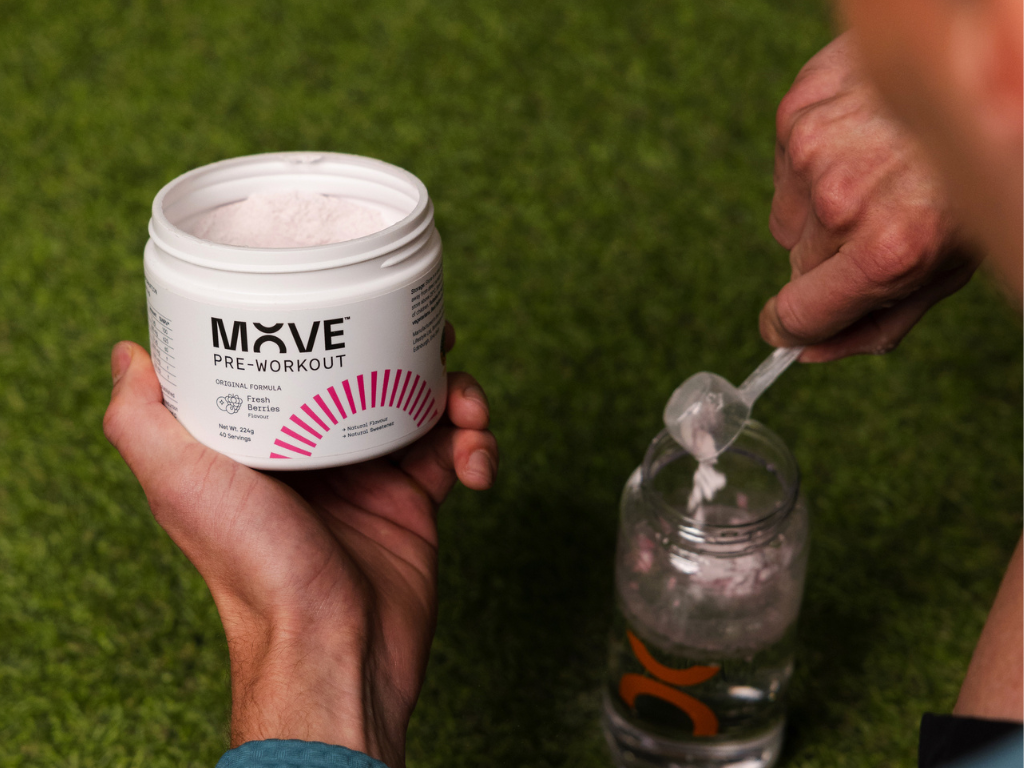
MOVE Endurance is designed specifically around these demands. Each serving combines 150 mg caffeine with taurine, blackcurrant extract, L-arginine, vitamin C and a meaningful electrolyte profile.


For long runs, it can be combined with MOVE Carb Booster to add 30 g of carbohydrate. For evening runs, MOVE Decaf provides caffeine-free support for focus, motivation and oxygen delivery without compromising sleep.

Title

What do runners actually need from a pre-workout?

Running pre-workout should be about more than creating a sudden burst of energy.


The demands of running depend on the type of session. A relaxed 40-minute jog, a hard interval workout and a three-hour long run are all running, but they create very different nutritional and physiological demands.


For harder or longer sessions, runners benefit from support in several areas:

- Mental focus and alertness

- Reduced perception of effort

- Muscular endurance and fatigue resistance

- Blood flow and oxygen delivery

- Fluid and electrolyte balance

- Carbohydrate availability

- Gastrointestinal comfort


A standard stimulant-only pre-workout might cover the first two. It doesn’t necessarily address the rest.


That’s why MOVE Endurance was created as a purpose-built endurance formula rather than simply using the same high-caffeine product for every type of training.


Each serving provides 150 mg caffeine, 1.5 g taurine, 900 mg blackcurrant extract, 2 g L-arginine, 500 mg vitamin C, 495 mg sodium, 726 mg chloride and 118 mg potassium.


The aim is to support the whole running session, not just the first 20 minutes.

Does pre-workout improve running performance?

A well-formulated pre-workout improves running performance by supporting both the brain and the working muscles.


Caffeine reduces perceived effort and improves alertness. Taurine supports muscle contraction and fatigue resistance. Blackcurrant extract supports vascular function, oxygen delivery and endurance metabolism. L-arginine and vitamin C support nitric-oxide availability and blood flow, while electrolytes contribute to hydration.


These effects are especially relevant during:

- Tempo runs

- Interval sessions

- Hill repetitions

- Long runs

- Trail running

- Race-pace sessions

- Hot-weather training

- Hybrid and conditioning workouts


Not every run needs a pre-workout. An easy recovery run after a good night’s sleep might need little more than water and a small carbohydrate snack.


The value increases when the session has a clear performance demand.


As a runner, I use pre-workout most deliberately before sessions where quality matters. If I’m heading out for intervals, a long run or a demanding hill session, I want to support the work properly. I don’t need to manufacture intensity before every easy run.

How does caffeine help runners?

Caffeine is one of the most effective acute performance supplements available to endurance athletes.


It works primarily by blocking adenosine receptors in the central nervous system. This increases alertness and reduces the perception of effort, helping runners sustain a given pace with less subjective strain.[1]


Scientific reviews and meta-analyses show that caffeine improves endurance performance across running, cycling and other prolonged exercise tasks.[1, 2, 3]

This doesn’t mean a runner suddenly feels no fatigue. It means the same pace becomes more tolerable, especially once the session becomes uncomfortable.


That matters during intervals, tempo running and racing. A large part of endurance performance involves managing effort as fatigue develops. Caffeine helps athletes continue producing work when the natural response is to slow down.

Why does MOVE Endurance contain 150 mg caffeine?

MOVE Endurance uses 150 mg caffeine rather than the larger 228 mg dose found in MOVE Strength.

The lower dose is deliberate.


A runner often needs to think beyond the start of the session. During a long run, marathon or ultramarathon, caffeine may also come from:


- Caffeinated gels

- Chews

- Sports drinks

- Cola

- Coffee

- Additional supplements later in the event


Starting with 150 mg gives the runner a meaningful performance dose without using most of their caffeine before the session has properly begun.


This is particularly relevant in my own ultra training. If I’m going to be running for four, five or more hours, I don’t want to use the largest dose possible before the first climb. I want enough caffeine to start focused, while keeping the option to use more when fatigue becomes much more significant later.


That controlled approach is usually more effective than treating caffeine as a single pre-run hit.

ENDURANCE Formula

Is more caffeine better before running?

More caffeine isn’t automatically better.


Higher doses increase the risk of:

- Shakiness

- Anxiety

- Elevated heart rate

- Gastrointestinal discomfort

- Poor pacing

- Sleep disruption

- A stronger perceived crash later


The right dose is the amount that improves the session without producing unnecessary side effects.


Some runners respond strongly to relatively modest intakes. Others tolerate more. Body mass matters, but habitual caffeine intake, genetics, anxiety levels and sleep status also influence the response.[1]


For endurance athletes, there is also a tactical reason to avoid excessively high starting doses. Caffeine can be more useful later in an event, when alertness and motivation begin to drop.

The goal isn’t to feel as stimulated as possible on the start line. The goal is to run well for the full session.

Title

When should runners take caffeine?

Taking MOVE Endurance approximately 30–60 minutes before running is a practical starting point.

This gives the caffeine time to be absorbed while allowing the runner to begin the session feeling alert and prepared.


However, MOVE Endurance can also be consumed during exercise.


A runner can mix one serving with around 500 ml water and sip it through the first hour of a long run. It can also be mixed into a more concentrated soft flask when carrying less fluid.


This can work particularly well for runners who don’t like drinking a large volume immediately before setting off.


I often find that sipping a drink during the early part of a long run feels more comfortable than consuming everything on the doorstep. The most important point is to practise the strategy and find an approach that feels natural.

How does taurine support running performance?

MOVE Endurance contains 1.5 g taurine.


Taurine is involved in calcium handling, muscle contraction, osmoregulation, antioxidant defence and fatigue regulation.


These processes matter during running because the muscles need to contract repeatedly, efficiently and under increasing fatigue.

Meta-analyses show that taurine improves endurance capacity and time-to-exhaustion performance.[4] Systematic reviews also support its use across endurance and high-intensity exercise.[5]


Taurine complements caffeine particularly well.


Caffeine primarily acts through the central nervous system, helping the runner stay alert and tolerate the effort.


Taurine supports processes within the muscle, contributing to contractile function and fatigue resistance.


That combination supports both how the effort feels and how the body sustains it.

Why is blackcurrant extract useful for runners?

Blackcurrant extract is one of the key endurance-specific ingredients in MOVE Endurance.

Each serving contains 900 mg blackcurrant extract, matching the dose used in acute running research.


Blackcurrants are rich in anthocyanins and other polyphenols. These compounds support:

- Nitric-oxide signalling

- Vascular function

- Blood flow

- Oxygen delivery

- Fat oxidation

- Fatigue resistance


Research using an acute 900 mg dose improved 5 km running performance.[6]


Additional studies have shown improvements in cycling performance and fat oxidation, supporting the wider endurance application of blackcurrant extract.[7, 8, 9]


For runners, these mechanisms become especially relevant as session duration increases.


A small improvement in vascular function or oxygen delivery might not feel dramatic during the first kilometre. Across a hard 5 km effort or a multi-hour long run, supporting these systems helps the athlete maintain pace and muscular function.


This is the type of ingredient that reflects the formulation philosophy behind MOVE Endurance. It isn’t included because it creates a strong physical sensation. It is included because its effects match what endurance athletes actually need.

How do L-arginine and vitamin C support runners?

MOVE Endurance combines 2 g L-arginine with 500 mg vitamin C.


L-arginine is a precursor for nitric oxide. Nitric oxide promotes vasodilation, which supports blood flow and the delivery of oxygen to working muscle.


A systematic review and meta-analysis found that L-arginine supplementation improves aerobic and anaerobic performance outcomes.[10]


Vitamin C supports endothelial function and helps protect nitric-oxide availability.[11]


The two ingredients therefore work through complementary parts of the same system:

- L-arginine provides the precursor for nitric-oxide production.

- Vitamin C supports the vascular environment and protects nitric-oxide availability.


For runners, the primary benefit is improved blood flow and oxygen delivery.

That supports the muscles’ ability to sustain repeated contractions and maintain output as fatigue develops.

Title

Why do electrolytes matter before running?

MOVE Endurance provides 495 mg sodium, 726 mg chloride and 118 mg potassium.

This gives the formula a meaningful hydration role.


Sodium and chloride are the main electrolytes lost in sweat. Potassium contributes to normal muscle function, fluid balance and neuromuscular signalling.


During longer runs, replacing electrolytes supports fluid retention and helps the athlete maintain hydration.[12]


The amount required depends on:

- Run duration

- Environmental temperature

- Sweat rate

- Sweat sodium concentration

- Fluid intake

- Individual tolerance


Some runners lose relatively little sodium. Others finish with salt marks across their clothing and can lose more than a gram per hour.


In my work with athletes, I don’t give everyone the same sodium target. I look at sweat rate, conditions, duration and the athlete’s history of cramping, thirst and fluid tolerance.


MOVE Endurance provides a strong starting point, particularly for longer sessions, warm-weather running and runners with moderate-to-high sweat losses.

Does every run require electrolytes?

No. A short easy run in cool weather won’t create the same electrolyte demands as a long run in summer.


For runs under an hour, normal meals and fluids often cover what is required, especially when sweat losses are low.


Electrolytes become increasingly useful when:

- Running for longer than 60–90 minutes

- Training in warm or humid conditions

- Sweating heavily

- Running indoors on a treadmill

- Completing a hard interval or conditioning session

- Beginning the session slightly dehydrated

- Running on consecutive days with limited recovery time


The key is to match the strategy to the session.


One of the most common mistakes in sports nutrition is treating every session as though it creates the same demands.

Title
Title

Does pre-workout provide enough carbohydrate for running?

MOVE CARB BOOSTER

MOVE Endurance doesn’t contain a fixed carbohydrate dose, which is intentional.


Carbohydrate needs vary enormously between a short run and an ultramarathon. Including a small amount inside every serving would either provide too much for some sessions or nowhere near enough for others.


MOVE Carb Booster allows carbohydrate to be added separately.


Each serving contains 30 g highly branched cyclic dextrin.


Highly branched cyclic dextrin has a high molecular weight and low osmolality. This allows it to provide carbohydrate in a relatively light drink.

Research shows that it empties from the stomach rapidly and produces fewer gastrointestinal problems than some traditional carbohydrate drinks during exercise.[13,14]


It also supports lower perceived effort and sustained endurance performance.[15,16]


When should runners add Carb Booster?

Carb Booster is most useful before or during:

- Long runs

- Marathon-pace sessions

- Extended interval workouts

- Trail runs

- Ultra training

- Double-session days

- Training started with low carbohydrate availability

- Runs lasting longer than approximately 60–90 minutes


One serving provides 30 g carbohydrate.


That makes it easy to build a fuelling plan:


- One serving = 30 g

- Two servings = 60 g

- Carb Booster plus a gel = a higher hourly target

- Carb Booster plus solid food = more variety during ultra training


For long events, it should form part of a wider hourly carbohydrate strategy rather than being treated as the whole plan.


In my own ultra preparation, I’m often targeting much higher carbohydrate intakes than one serving can provide. Carb Booster gives me a useful base that I can combine with gels, rice bars or other food.

MOVE CARB BOOSTER

Why is gastrointestinal comfort important for runners?

Running creates a particularly challenging environment for the gut.


Repeated impact, changes in blood flow, dehydration and concentrated carbohydrate drinks can all contribute to gastrointestinal discomfort.


Common problems include:

- Bloating

- Nausea

- Stomach heaviness

- Cramping

- Reflux

- Urgency

- Diarrhoea


A pre-workout or fuelling product is only useful if the runner can tolerate it.

Highly branched cyclic dextrin is valuable because its high molecular weight creates a lower-osmolality solution than many simple carbohydrate drinks.


This supports gastric emptying and helps avoid the overly sweet, heavy drink that many runners struggle with during longer sessions.[13,14]


MOVE Carb Booster is also unflavoured, so it can be added to MOVE Endurance without creating an excessively sweet combination.


That becomes increasingly important during multi-hour training, where flavour fatigue can become a genuine barrier to adequate fuelling.

What should you take before an easy run?

An easy run doesn’t always need a pre-workout.


If the run is short, the weather is cool and you’re well rested, water or a small carbohydrate snack may be enough.


MOVE Endurance can still be useful when:

- The run is early in the morning

- You feel mentally flat

- It is part of a higher-volume training week

- You are running in the heat

- You sweat heavily

- You need to practise a race strategy


MOVE Decaf can be the better option for an easy evening run when you want the pre-training routine without caffeine.


The product should always have a reason for being there.

MOVE ENDURANCE COMPLETE BUNDLE

What should you take before intervals?

MOVE Endurance is the best fit for most interval sessions.

Intervals require:


- Mental focus

- Tolerance of high perceived effort

- Repeated muscular contractions

- Oxygen delivery

- Recovery between efforts

- Hydration


The combination of caffeine, taurine, blackcurrant extract, L-arginine, vitamin C and electrolytes supports each of these areas.


For very short sprint sessions with long recovery periods, MOVE Strength can also be appropriate because the higher caffeine dose and additional L-tyrosine support explosive output and strong mental drive.


The distinction comes down to the nature of the workout.

Repeated aerobic or mixed intervals favour MOVE Endurance.

Short, highly explosive sprint work can favour MOVE Strength.

What should you take before a tempo run?

MOVE Endurance is the clearest choice before tempo running.


Tempo sessions require the runner to maintain a controlled but uncomfortable effort for an extended period.


Caffeine reduces perceived effort, while taurine supports muscular endurance. Blackcurrant extract and the L-arginine plus vitamin C combination support oxygen delivery, and the electrolytes contribute to hydration.


For longer tempo sessions or marathon-pace runs, adding Carb Booster provides carbohydrate to support sustained pace.

What should you take before a long run?

A long run usually requires more than a pre-workout alone.


A complete strategy should consider:

- Pre-run meal

- Carbohydrate intake

- Fluid

- Electrolytes

- Caffeine

- Equipment and carrying capacity

- Refilling opportunities

- Gastrointestinal tolerance


MOVE Endurance provides the pre-workout and hydration foundation.


MOVE Carb Booster adds 30 g carbohydrate per serving.


For longer sessions, gels, chews or food can be added to reach the planned hourly target.

This is how I approach my own long runs. The pre-workout is one part of the strategy, not the whole strategy.


If I’m going out for several hours, I’m thinking about what I’ll carry, where I can refill, how much carbohydrate I’ll need and when I might want additional caffeine.

What should you take before trail and ultra running?

MOVE Endurance is especially well suited to trail and ultra running.


These sessions require sustained alertness, hydration, muscular endurance and the ability to manage fatigue over many hours.


The lower 150 mg caffeine dose allows the athlete to begin with useful stimulation while keeping additional caffeine available later.


The electrolyte profile supports hydration, while taurine and blackcurrant extract target fatigue resistance and endurance performance.


Carb Booster provides a scalable carbohydrate base.


Trail and ultra runners should still practise their complete strategy repeatedly. This includes drinking while climbing, fuelling on descents, opening products with cold hands and carrying enough backup options.


The science matters, but the practical system is what delivers it.

What should you take before running in the heat?

Running in the heat increases sweat losses, cardiovascular strain and perceived effort.

MOVE Endurance is the best option because it combines caffeine with a meaningful electrolyte profile.


The 495 mg sodium and 726 mg chloride support fluid balance and sweat-loss replacement, while potassium contributes to normal muscle function. The drink should still be mixed with an appropriate amount of fluid.


A runner with a high sweat rate may require additional fluid and sodium beyond one serving, particularly during a long session.


Pre-cooling, sensible pacing and access to fluid remain important. A pre-workout supports the plan, but it doesn’t remove the physiological demands of heat.

What should you take before an evening run?

MOVE Decaf is the better option before evening running.

Caffeine reduces sleep duration and sleep quality, particularly when higher doses are consumed closer to bedtime.[17,18]


MOVE Decaf supports attention, motivation and oxygen delivery without caffeine.

The formula includes L-tyrosine, L-theanine, CDP choline, Panax ginseng, Mucuna pruriens, L-arginine and vitamin C.


This creates a caffeine-free option for runners who still want to feel focused and prepared without damaging sleep.


There’s little value in improving one evening run if poor sleep then compromises recovery and the next day’s training.

MOVE DECAF

Title

Is MOVE Strength suitable for runners?

MOVE Strength can suit certain running sessions, but MOVE Endurance is the better default choice for most runners.


MOVE Strength is most relevant for:

- Short sprint sessions

- Explosive hill sprints

- Gym-based running conditioning

- Very short, high-intensity workouts

- Runners completing a strength session before or after running


Its 228 mg caffeine and 2 g L-tyrosine provide stronger stimulation and cognitive drive.

However, it doesn’t contain the taurine, blackcurrant extract or electrolyte profile included in MOVE Endurance.


For sustained running, MOVE Endurance better matches the demands of the sport.

Can runners use Creatine Booster?

Yes. Creatine is often associated only with bodybuilding or strength athletes, but runners can also benefit, particularly when they combine endurance training with strength, sprinting or high-intensity work.


Creatine improves strength, power, repeated high-intensity performance and training adaptation.[19, 20, 21, 22, 23]


MOVE Creatine Booster provides 5 g creatine monohydrate per serving.


It can be mixed with MOVE Endurance, but it doesn’t need to be taken immediately before running.

Consistent daily intake matters more than exact timing.


For runners, creatine is especially useful during:

- Strength-training blocks

- Hill and sprint development

- Injury rehabilitation

- Hybrid training

- Periods where preserving muscle and power matters

Title

What are the most common pre-workout mistakes runners make?

Taking too much caffeine

A very high dose can increase anxiety, heart rate and gastrointestinal discomfort without producing a better run.

Ignoring carbohydrate

Caffeine can make a runner feel more alert, but it doesn’t replace carbohydrate during long or demanding exercise.

Drinking too much immediately before starting

A large fluid volume can feel uncomfortable once the runner begins moving. Sipping MOVE Endurance during the early part of the session can work better.

Trying a new strategy on race day

Every product, dose, concentration and timing strategy should be practised during training.

Using caffeine too late

An evening pre-workout can compromise sleep and recovery. MOVE Decaf is the better option.

Treating every run the same

An easy recovery run and a three-hour long run don’t require the same strategy.

Tom’s Take

I’ve used pre-workout very differently as my own training has shifted from being mainly strength-based to combining strength work with marathon and ultra-endurance running.


Before a heavy gym session, I’m happy to use a stronger caffeine dose upfront because the session is relatively short and the work is highly concentrated. Running is different.


Before intervals, I want focus and the ability to tolerate a high level of effort. Before a long run, I’m thinking several hours ahead. Hydration, carbohydrate and caffeine timing all become part of the same plan.


I don’t want to feel brilliant for the first hour and then realise I’ve used most of my caffeine, underfuelled and carried too little fluid.


That’s why MOVE Endurance makes sense as a running formula. It isn’t simply trying to make the start feel more intense. It supports the systems that matter as the session continues.


That’s also how I work with endurance athletes. We start with the demands of the run, then build the strategy around it. Sometimes that means MOVE Endurance on its own. Sometimes it means adding Carb Booster. Sometimes the best option is Decaf because the session is late and protecting sleep matters more.


The best pre-workout for running is the one that helps you execute the whole session, not just feel excited at the start.

Complete Endurance Setup

£49.98

Combine MOVE Endurance for hydration, stamina and energy with Carb Booster for clean, sustained fuel to power longer, harder sessions. Available in 3 flavours.

Flavour
Quantity

Complete Endurance Setup

£49.98

Combine MOVE Endurance for hydration, stamina and energy with Carb Booster for clean, sustained fuel to power longer, harder sessions. Available in 3 flavours.

Flavour
Quantity