Pre-Workout Tubs vs Sachets - Which Format Suits You

  • By Tom Coughlin

Published: Thursday, October 8th, 2026

Quick answer

If you use pre-workout regularly at home, a tub is usually the best-value and simplest option.

If you travel, race, train straight from work or regularly carry supplements in a gym bag, sachets are more convenient because each serving is already measured and individually sealed.

There is no performance difference between the same MOVE formula in a tub or sachet. The active ingredients and serving are the same.

For me, it isn’t really tubs versus sachets.

I use tubs for everyday training and sachets when convenience, portability and exact portioning matter more.

Title

Tubs vs sachets at a glance

For example, MOVE Strength and Endurance tubs currently cost £27.99 for 30 servings, around £0.93 per serving. The equivalent 30-sachet packs are £32.99, or around £1.10 per serving before subscription pricing.[2-5]

So the decision is really whether the extra convenience of individual sachets is worth roughly 17p per serving to you.

Does a sachet work differently from a tub?

No.

If the formula and serving size are the same, your body doesn’t care whether the powder came from a tub or an individual sachet.

MOVE Strength still provides the same caffeine, L-tyrosine and L-arginine whether you scoop it from a tub or tear open a sachet.

The same applies to MOVE Endurance.

You still get the same 150 mg caffeine, taurine, blackcurrant extract, L-arginine and electrolyte profile.

The packaging changes.

The physiology doesn’t.

That sounds obvious, but sports nutrition marketing can sometimes make different formats sound as though they somehow produce different performance effects.

They don’t.

Choose the format that makes it easiest for you to use the product properly.

Why choose a pre-workout tub?

The biggest advantage is value.

If you train from home, drive to the gym or generally prepare your pre-workout in your own kitchen, carrying 30 individual sachets doesn’t add much.

A tub gives you the full product in one container and currently works out cheaper per serving.

For MOVE Strength and Endurance, the difference is currently around:

Tub: £27.99 / 30 servings = approximately £0.93 per serving.

30 sachets: £32.99 / 30 servings = approximately £1.10 per serving.[2-5]

That difference is small on any individual training day.

But over hundreds of sessions, it adds up.

If I knew I was training in the gym four times per week and almost always taking my pre-workout from home, I’d buy the tub.

You’re paying for the formula rather than additional convenience packaging.

When are sachets worth paying more for?

When they solve an actual problem.

This is the way I think about most sports nutrition products.

Convenience has value when it improves execution.

A sachet becomes useful when you:

  • Train straight from work
  • Carry pre-workout in your gym bag
  • Travel regularly
  • Race away from home
  • Fly with supplements
  • Attend training camps
  • Play away fixtures
  • Want servings ready to distribute across a team
  • Don’t want to carry a full tub
  • Want an exact serving without measuring powder

In those situations, paying slightly more per serving starts to make sense.

The supplement that stays in the kitchen while you’re 300 miles away at a race isn’t particularly useful.

Are sachets more accurate?

They remove one small source of user error.

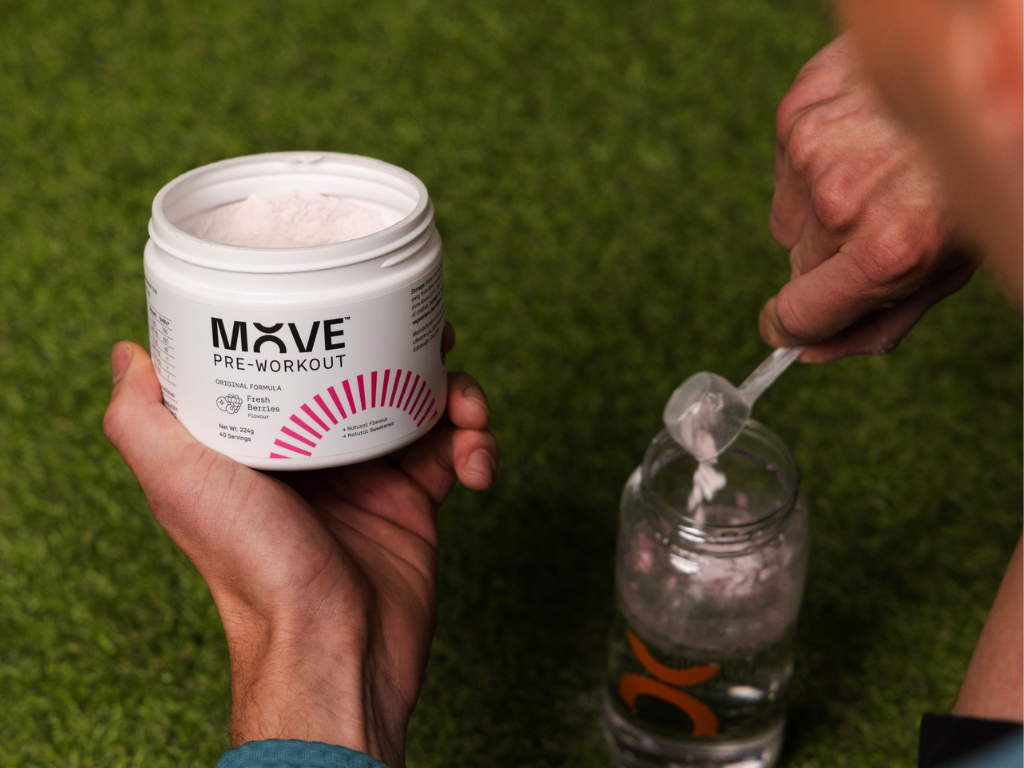
With a tub, you need to measure the stated serving.

That isn’t difficult, but it relies on you actually using the scoop properly rather than throwing in whatever amount happens to look right.

With a sachet, the serving has already been portioned.

Open it.

Add it to your bottle.

Drink it.

That becomes particularly relevant with caffeinated products.

Caffeine has a clear dose-response relationship, but more caffeine doesn’t automatically mean more performance. Larger doses can also increase unwanted effects such as anxiety, gastrointestinal discomfort and sleep disruption.[1]

So I quite like the certainty of a pre-measured sachet in situations where I specifically want the strategy to be repeatable.

That might be a competition, a race or an important training session.

At home, accurately measuring a scoop is hardly a major challenge.

But when I’m standing beside a car at 6 am before a race, simplicity becomes more valuable.

Which format is better for race day?

Sachets.

For me, this is probably the clearest use case.

Race morning already involves enough organisation.

Shoes.

Kit.

Race number.

Gels.

Fluids.

Electrolytes.

Carbohydrate.

Travel.

Warm-up.

The last thing I want is to bring a full tub of pre-workout just so I can measure eight grams of powder into a bottle.

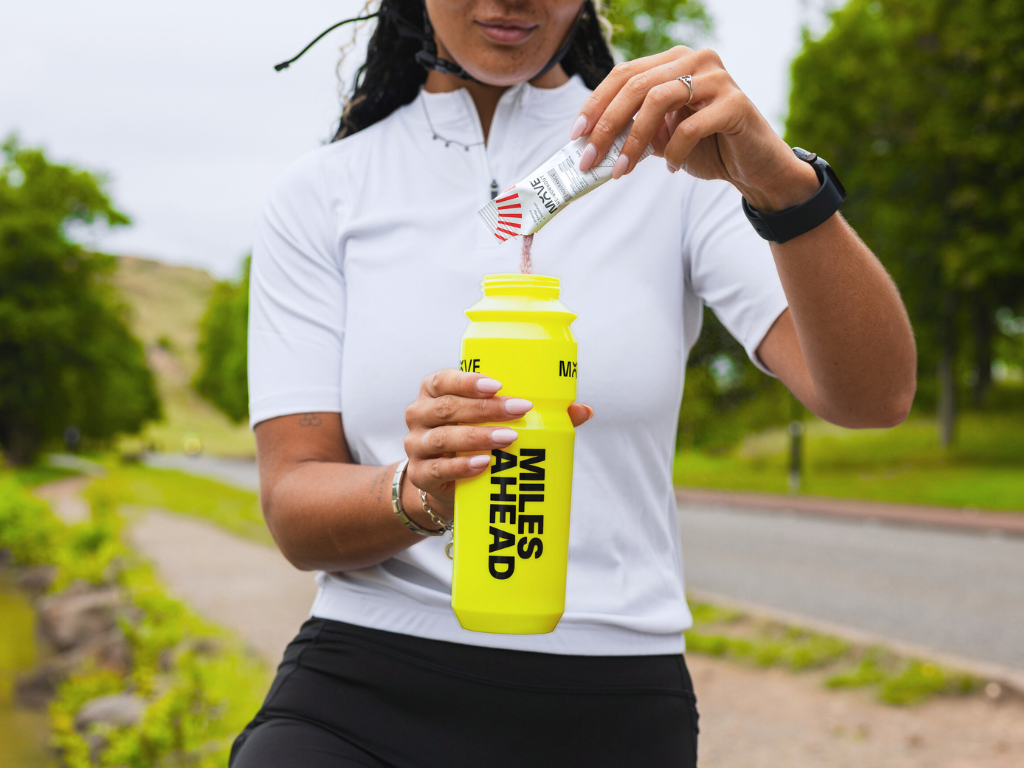
With a MOVE Endurance sachet, the dose is already there.

Tear it open, pour it into the bottle or soft flask and move on.

MOVE Endurance sachets are specifically available as grab-and-go servings for runners and endurance athletes, while the current race-day bundles also combine sachets with Carb Booster and a 500 ml soft flask.[5,9]

For races, that’s a much better format.

Title

What about long runs and cycling?

Again, sachets become very useful.

You might start from somewhere other than home.

You might drive to a trail.

You might be meeting a training group.

You might be staying overnight before an event.

A sachet can sit in your running vest, cycling bag or car without requiring any planning.

It also becomes easier to carry a second serving or Carb Booster without decanting powder into random bags.

I’ve done enough long-distance running now to appreciate how quickly small organisational annoyances start adding up.

My fuelling strategy can be scientifically detailed.

My actual race bag needs to be incredibly simple.

That’s where sachets work well.

Which format is better for gym training?

If you usually prepare your drink at home, I’d go with a tub.

Strength Formula currently comes in both formats, with the 30-sachet pack providing the same 228 mg caffeine, 2 g L-tyrosine and 2 g L-arginine as the tub.[2,3]

But if you go directly from work to the gym, sachets can be much more practical.

Leave a few in your bag.

You don’t have to remember the whole tub every morning.

You also avoid the classic scenario where you’ve brought your shaker, clothes and shoes but left the pre-workout sitting on the kitchen counter.

The best format depends more on your routine than your training goal.

MOVE Strength

What about travelling with supplements?

This is another situation where I strongly prefer sachets.

Thirty servings of powder take up noticeably more room when they’re contained inside a full-size tub.

If I’m travelling for a few days, I don’t need 30 servings.

I need two or three.

Sachets let me pack exactly what I need without decanting powder.

That is also useful from a simple identification perspective.

A branded sachet containing the original product is much easier to recognise than an unlabelled plastic bag containing mysterious white powder.

I’ve travelled extensively with professional teams, and small details like this genuinely make sports nutrition logistics easier.

You don’t want the athlete thinking about how much powder to measure or which anonymous bag contains which supplement.

You want the process to be obvious.

Why are sachets useful in team sport?

Distribution.

Imagine trying to provide pre-workout to 25 players before an away fixture.

A tub means somebody has to portion every serving.

You need a scoop.

You need the tub.

You need to make sure everyone receives the correct quantity.

Individual sachets simplify that entire process.

One player.

One sachet.

One serving.

That’s one reason individually portioned sports nutrition products are so useful in professional environments.

It’s not necessarily that the product is nutritionally superior.

It reduces friction.

And in applied sports nutrition, reducing friction is often what makes a strategy actually happen.

Title

Are sachets better for drug-tested athletes?

The formula and independent testing matter more than the packaging format.

MOVE Strength and Endurance are Informed Sport approved whether they are sold in tubs or sachets.[10,11]

Informed Sport recommends that athletes verify the batch number of certified supplements against its database. Certified products undergo screening for substances prohibited in sport, and tested batches can be searched by product, brand or batch number.[12]

So a sachet isn’t inherently “safer” than a tub containing the same certified formula.

But individual packaging can be practically useful.

It keeps the product identified rather than requiring you to decant powder into another container.

For competitive athletes, I generally prefer keeping supplements in recognisable original packaging wherever it’s practical to do so.

Do tubs stay fresh for as long as sachets?

Both are designed to remain stable when stored according to their instructions.

But there is a practical difference.

Every time you open a tub, the remaining powder is exposed to the surrounding environment.

That normally isn’t an issue if you close the lid properly and store it somewhere cool and dry.

But moisture can cause powdered supplements to clump.

A sachet remains individually sealed until you use it.

So if you’re only taking pre-workout occasionally, sachets can be convenient because the rest of your servings remain unopened.

If you’re using a tub several times each week, this is unlikely to be a meaningful concern provided you store it properly.

Is a tub better environmentally?

A tub consolidates many servings into one larger container.

Sachets require an individual wrapper for every serving.

So in straightforward packaging terms, sachets create more individual pieces of packaging per serving.

I’d be cautious about turning that into a sweeping environmental claim without considering the entire manufacturing, transport and recycling lifecycle.

But if your priority is simply minimising the amount of individual packaging you use, a tub is the obvious choice.

That is another reason I’d use tubs for regular home training and save sachets for the situations where their convenience genuinely adds something.

Can you change the dose more easily with a tub?

Technically, a tub gives you more freedom to alter the amount of powder you use.

But I don’t see that as a major advantage.

MOVE has been formulated around a defined serving.

If you start casually adding one and a half or two scoops because you want a “stronger” session, you’re also substantially increasing your caffeine intake.

For MOVE Strength, one serving already provides 228 mg caffeine.

Two servings would mean 456 mg.

That isn’t how I’d use the product.

If the serving is appropriate, take the serving.

If the caffeine dose isn’t appropriate for you, choose a different strategy rather than treating the scoop as a volume control for stimulation.

Title

What if you want less caffeine?

Choose the formula rather than randomly altering the serving.

MOVE Endurance provides 150 mg caffeine compared with 228 mg in Strength.

MOVE Decaf provides none.

That gives you much clearer control over your caffeine strategy.

Decaf is currently available as individually portioned sachets and provides 400 mg L-theanine, 500 mg CDP choline, 1.5 g L-tyrosine and other caffeine-free ingredients targeting cognitive readiness.[6]

If I’m training late, I’d much rather use a properly formulated Decaf serving than guess at half a scoop of a caffeinated product.

MOVE Decaf

What about trial packs?

This is another area where sachets are particularly useful.

If you haven’t used a product before, buying 30 servings of a flavour you’ve never tasted is a commitment.

MOVE currently has smaller trial formats, including a seven-sachet Endurance trial pack and a Hybrid Trial Pack containing both Strength and Endurance formulas.[7,8]

That lets you test:

Taste.

Tolerance.

Caffeine response.

How the product sits in your stomach.

Where it fits into your routine.

Then, once you know you’re going to use it regularly, moving to a tub makes economic sense.

That’s how I’d approach it.

Title

Which is best value: tubs or sachets?

For regular use, tubs.

Current one-off pricing makes the comparison fairly straightforward for both Strength and Endurance:

30-serving tub: £27.99 — approximately £0.93 per serving.

30-sachet pack: £32.99 — approximately £1.10 per serving.[2-5]

That’s roughly a £5 difference across 30 sessions.

You’re effectively paying that extra amount for individual packaging and convenience.

For someone training four or five times per week from home, I’d take the cheaper tub.

For someone travelling every week or regularly racing, I’d happily pay the difference.

Value isn’t just price.

It’s whether the product fits the way you actually train.

Should you buy both?

For plenty of athletes, that is probably the most practical answer.

You don’t have to declare yourself either Team Tub or Team Sachet.

Keep the tub at home.

Keep sachets in your gym bag.

Use the tub for normal training.

Use sachets for travel, races and days when you’re going directly from work to training.

You get the lower cost per serving most of the time without giving up convenience when you need it.

That is how I tend to think about these things.

Title

Tom’s Take

For me, this isn’t really a debate about which format is better.

It’s about where I’m going to use it.

If I’m training from home, I want the tub. It’s cheaper, it sits in the kitchen and measuring one scoop isn’t exactly a difficult part of my day.

If I’m racing, doing a long run somewhere else or travelling, I want sachets.

I definitely don’t want to arrive at an ultra with a massive tub of Endurance in my drop bag just so I can measure one serving before the start.

The same applies in elite sport. If you’ve got a squad travelling for an away game, individual servings make life easier. You know what everyone has, there’s no measuring and there’s less room for confusion.

That’s probably the key message.

Don’t pay extra for convenience you never use.

But don’t underestimate how valuable convenience becomes when it makes the nutrition strategy easier to execute.

At home: tub.

On the move: sachet.


References

1. Guest NS, VanDusseldorp TA, Nelson MT, Grgic J, Schoenfeld BJ, Jenkins NDM, et al. International Society of Sports Nutrition position stand: caffeine and exercise performance. J Int Soc Sports Nutr. 2021;18(1):1.

2. MOVE Pre-Workout. Strength Formula Tub [Internet]. 2026 [cited 2026 Oct 1].

3. MOVE Pre-Workout. Strength Formula Sachets (30 Pack) [Internet]. 2026 [cited 2026 Oct 1].

4. MOVE Pre-Workout. Endurance Formula Tub [Internet]. 2026 [cited 2026 Oct 1].

5. MOVE Pre-Workout. Endurance Formula Sachets (30 Pack) [Internet]. 2026 [cited 2026 Oct 1].

6. MOVE Pre-Workout. Decaf Formula Sachets (15 Pack) [Internet]. 2026 [cited 2026 Oct 1].

7. MOVE Pre-Workout. Endurance Formula Trial Pack (7 Sachets) [Internet]. 2026 [cited 2026 Oct 1].

8. MOVE Pre-Workout. Hybrid Trial Pack (7 Sachets) [Internet]. 2026 [cited 2026 Oct 1].

9. MOVE Pre-Workout. Endurance [Internet]. 2026 [cited 2026 Oct 1].

10. Informed Sport. Move Pre-Workout Original Formula [Internet]. [cited 2026 Oct 1].

11. Informed Sport. Endurance [Internet]. [cited 2026 Oct 1].

12. Informed Sport. Athletes [Internet]. [cited 2026 Oct 1].

Hybrid Starter Bundle

£79.99

Built for athletes who train strength and endurance, with MOVE Strength, MOVE Endurance, Creatine Booster sachets, a FREE premium shaker (worth £9.99) and FREE performance tee (worth £25) to fuel every session. Mix & match your flavours.

Endurance Formula Tub (Flavour)
Strength Formula Tub (Flavour)
MOVE MILES AHEAD T-Shirt (White) (Size (Unisex))
Quantity