Pre-Workout vs Coffee: Which Is Better Before Training?

  • By Tom Coughlin

Published: Thursday, October 1st, 2026

Quick answer

Both coffee and pre-workout can improve training performance because both can provide caffeine.

Research shows that caffeinated coffee can improve endurance, strength and high-intensity exercise performance, and when caffeine doses are matched, coffee can perform similarly to isolated caffeine in several studies.[1, 2, 3, 4]

The main advantage of a dedicated pre-workout is control and specificity.

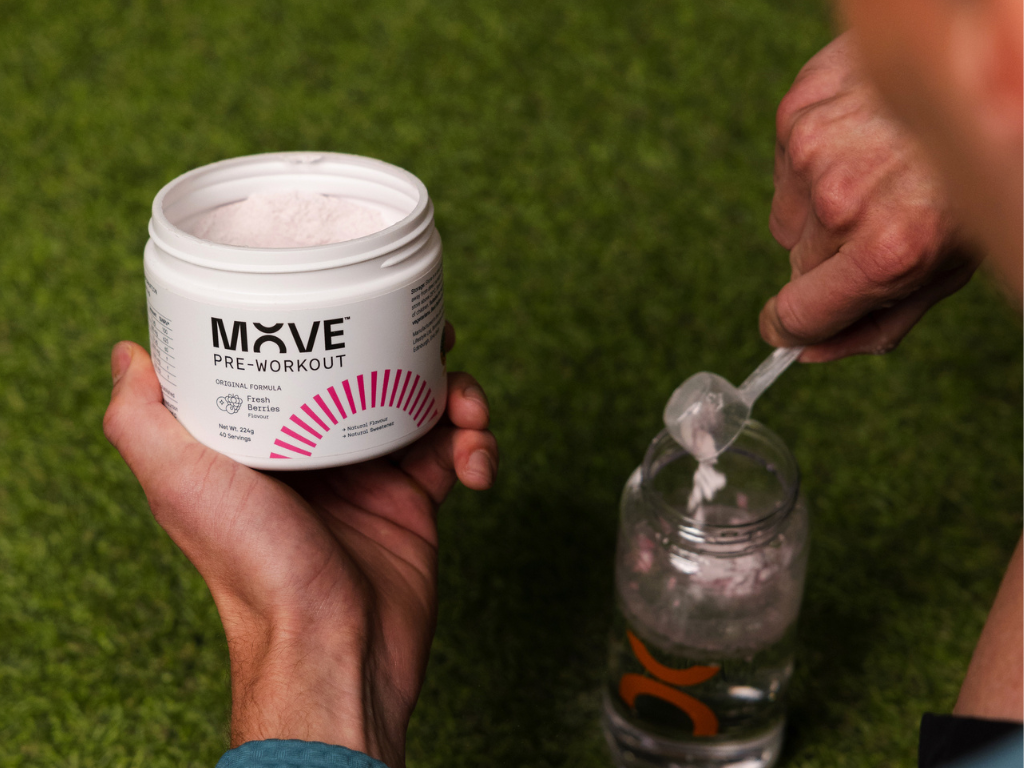
Coffee can contain dramatically different amounts of caffeine depending on the beans, serving size and preparation method. MOVE Strength provides a repeatable 228 mg caffeine dose, alongside 2 g L-tyrosine and 2 g L-arginine with vitamin C to support focus, training intensity and oxygen delivery.

If all you want is some caffeine before an everyday session, coffee is a perfectly good option.

If the session matters and you want a consistent, purpose-built performance strategy, I’d choose pre-workout.

Title

Pre-workout vs coffee at a glance

The important point is that coffee isn’t a bad pre-workout.

The question is whether caffeine alone is all you want from your pre-training strategy.

Does coffee actually work as a pre-workout?

Yes.

Coffee has sometimes been treated as though it’s an inferior form of caffeine because it contains hundreds of other compounds alongside the caffeine.

The research doesn’t really support that view.

An International Society of Sports Nutrition position stand concluded that coffee can improve performance across a wide range of exercise tasks, including endurance and shorter-duration activity.[5]

An evidence-based review of coffee before endurance exercise also found moderate evidence that caffeinated coffee improves running and cycling performance.[6]

So if someone tells me they drink coffee before training and asks whether they need to replace it with pre-workout, my answer is no.

If the coffee gives them an appropriate caffeine dose, they tolerate it well and they enjoy drinking it, it can absolutely form part of a good pre-training routine.

The advantages of pre-workout come from what you can do beyond simply getting caffeine into the body.

Why does caffeine improve training performance?

Caffeine acts primarily by blocking adenosine receptors in the central nervous system.

Adenosine contributes to feelings of tiredness and increasing perceived effort. Blocking those receptors helps you feel more alert and makes hard exercise feel more manageable.

That translates into improvements across several forms of performance.

Scientific reviews show caffeine improves:

• Endurance performance

• Muscular endurance

• Strength

• Movement velocity

• Sprinting

• Jumping

• High-intensity exercise performance.[1,7]

An umbrella review of 21 meta-analyses found beneficial effects across aerobic endurance, muscle strength, muscle endurance and power outcomes.[7]

That means the caffeine in a cup of coffee and the caffeine in a pre-workout are acting through essentially the same underlying pathway.

Caffeine doesn’t become better caffeine just because it comes out of a tub.

Can coffee perform as well as isolated caffeine?

In some studies, yes.

One of the most useful direct comparisons came from Hodgson and colleagues.

Trained cyclists and triathletes consumed either coffee providing 5 mg/kg caffeine, isolated caffeine at the same dose, decaffeinated coffee or placebo before endurance exercise.

Both caffeinated coffee and isolated caffeine improved time-trial performance compared with placebo, with no meaningful performance difference between the two caffeine sources.[2]

Similar findings have been reported in high-intensity exercise.

Trexler and colleagues compared coffee containing approximately 303 mg caffeine with 300 mg anhydrous caffeine in resistance-trained men. Coffee and caffeine produced broadly similar effects across the strength and sprint protocol.[3]

Another resistance-training study found that caffeinated coffee improved squat exercise performance compared with placebo.[4]

So the science doesn’t support the idea that you have to consume caffeine as a powder or capsule for it to work.

Coffee is a legitimate ergogenic aid.

Title

So why would you choose pre-workout instead?

The biggest reason is precision.

With a formulated pre-workout, you know how much caffeine you’re getting.

With coffee, that can be surprisingly difficult.

Cup size, bean variety, roast, grind size, brewing method, extraction time and the amount of coffee used all affect the final caffeine dose.

One study examining 104 coffees purchased in Scotland, Italy and Spain found caffeine contents ranging from 48 mg to 317 mg per serving.[8]

Another investigation of commercial espresso found values ranging from 25 mg to 214 mg per serving.[9]

Even the same drink from the same outlet can vary.

That doesn’t make coffee unsafe or ineffective.

It just means “I had a coffee” isn’t a very precise caffeine strategy.

Why does caffeine consistency matter?

Imagine you normally drink a coffee containing 90 mg caffeine before training.

One morning you buy a different coffee and unknowingly get 200 mg.

That can feel completely different.

Your perceived energy, heart rate, gastrointestinal response and subsequent sleep could all change.

The opposite is also possible.

You expect your usual caffeine effect but happen to get a relatively weak coffee before an important session.

A standardised pre-workout removes much of that uncertainty.

MOVE Strength provides 228 mg caffeine per serving.

That means you can practise the dose, understand how you respond to it and repeat the strategy when you need it.

This is especially useful around competitions, testing sessions or important training days where I want fewer variables.

MOVE Strength

Is 228 mg caffeine better than a cup of coffee?

Not simply because the number is larger.

The right caffeine dose depends on the person.

Research has traditionally used around 3–6 mg/kg body mass, although lower doses can also improve performance.[1]

For an 80 kg athlete, 228 mg provides approximately 2.9 mg/kg.

For a 70 kg athlete, it provides around 3.3 mg/kg.

So MOVE Strength lands around the lower end of that well-established performance range for many athletes without automatically moving into very high stimulant doses.

That was deliberate.

I don’t think the aim of a pre-workout should be to cram as much caffeine into the serving as possible.

I want enough to get the performance effect while keeping the dose manageable.

What does MOVE Strength give you that coffee doesn’t?

This is where the comparison becomes less about coffee versus caffeine and more about coffee versus a formulated pre-workout.

MOVE Strength provides:

• 228 mg caffeine

• 2 g L-tyrosine

• 2 g L-arginine

• 500 mg vitamin C

The caffeine is still doing a lot of the heavy lifting acutely.

But the other ingredients allow us to target different aspects of the training session.

L-tyrosine supports cognitive performance and catecholamine production.

L-arginine and vitamin C target nitric-oxide availability, vascular function and oxygen delivery.

Coffee isn’t formulated to do those jobs.

Title

Why add L-tyrosine?

Tyrosine is an amino acid used in the production of catecholamines including dopamine and noradrenaline.

Those neurotransmitters are involved in motivation, attention and the response to physical and psychological stress.

Scientific reviews suggest that tyrosine supplementation can support cognitive performance when people are exposed to demanding conditions, fatigue or sleep restriction.[10,11]

MOVE Strength contains 2 g L-tyrosine alongside caffeine.

That combination makes sense to me before difficult strength sessions.

There’s obviously a physical side to heavy training, but there’s a mental side too.

You need to concentrate.

You need to commit to hard sets.

You need to stay engaged once the session becomes uncomfortable.

Coffee gives you caffeine.

MOVE gives you caffeine plus a dedicated cognitive-performance ingredient.

Why include L-arginine and vitamin C?

MOVE Strength also provides 2 g L-arginine and 500 mg vitamin C.

L-arginine is used to produce nitric oxide, which contributes to vasodilation and blood flow.

A systematic review and meta-analysis found that L-arginine supplementation improves aerobic and anaerobic exercise performance.[12]

Vitamin C supports endothelial function and nitric-oxide availability, providing a complementary pathway alongside arginine.[13]

I prefer talking about this in terms of blood flow and oxygen delivery rather than making exaggerated claims around muscle “pump”.

The point is to support another aspect of the physiology involved in training.

Again, you’re moving beyond what caffeine alone can provide.

Does coffee have benefits beyond caffeine?

Absolutely.

It would be unfair to describe coffee as nothing more than caffeine dissolved in hot water.

Coffee is a complex drink containing hundreds of compounds, including chlorogenic acids and other polyphenols.[5]

Those compounds have antioxidant, vascular and metabolic effects, and there is ongoing research into whether the coffee matrix influences performance and recovery independently of caffeine.

This is actually one of the interesting things about comparing coffee with isolated caffeine.

Coffee isn’t a less sophisticated substance.

Biologically, it’s arguably more complex.

The difference is that it wasn’t designed specifically around the demands of your training session.

That’s where a purpose-built pre-workout has the advantage.

Does coffee dehydrate you before training?

Not in the way people sometimes assume.

Caffeine can have a mild diuretic effect at rest, particularly at larger doses.

But exercise changes the picture.

A meta-analysis examining caffeine and urine production found that the small diuretic effect seen at rest was effectively negated during exercise.[14]

So having coffee before training isn’t automatically going to dehydrate you.

The more relevant issue is whether you are adequately hydrated overall.

A small espresso before a two-hour run obviously doesn’t provide much fluid.

A large coffee does.

For longer endurance sessions, I’d still prefer a structured hydration strategy rather than expecting coffee to cover it.

That’s where MOVE Endurance becomes more relevant than MOVE Strength because it combines caffeine with sodium, chloride and potassium.

Title

Which is better before strength training?

For an everyday gym session, either can work.

If you enjoy a coffee, know roughly how much caffeine it contains and simply want some stimulation before training, I have no problem with that.

For a genuinely demanding strength session, I’d choose MOVE Strength.

The reasons are:

• A known 228 mg caffeine dose

• 2 g L-tyrosine for cognitive readiness

• L-arginine and vitamin C for blood-flow and oxygen-delivery support

• Easy repeatability between sessions

I’ve been strength training for around 15 years, and the consistency piece matters more to me now than it probably did when I first started.

I don’t need every session to feel like I’ve been hit by a stimulant.

I want something predictable that helps me train well.

MOVE Strength

Which is better before running?

This is where I’d actually move away from MOVE Strength.

Coffee can still work extremely well before running.

Research supporting coffee as an endurance aid is fairly strong, particularly when enough caffeine is consumed.[2,5,6]

But for a performance-focused run, I’d generally choose MOVE Endurance instead.

That gives you:

• 150 mg caffeine

• Taurine

• 900 mg blackcurrant extract

• L-arginine

• Sodium, chloride and potassium

That formula is much closer to the actual demands of running.

A coffee gives you caffeine.

Endurance gives you caffeine plus hydration and additional endurance-specific support.

So the better MOVE comparison changes with the session.

Title

Is coffee cheaper?

Usually.

If you make coffee at home, it can be an extremely inexpensive way to consume caffeine.

That is a genuine advantage.

You also get the ritual of drinking coffee, which plenty of athletes enjoy.

Pre-workout is more specialised.

You’re paying for standardisation, additional ingredients and convenience around training.

That doesn’t mean everyone needs it.

If someone already drinks coffee, trains recreationally and gets everything they want from that routine, I’m not going to tell them they need another supplement purely for the sake of it.

The question is whether the additional features of the pre-workout are useful to you

Which is easier on the stomach?

This is individual.
Some athletes tolerate coffee extremely well.
Others find that a large hot coffee shortly before training increases bowel urgency, reflux or general stomach discomfort.
The total volume matters too.
Drinking a large coffee before heavy squats can feel very different from taking a smaller volume of pre-workout.
Equally, some people dislike sports supplements and find coffee easier to tolerate.
There isn’t a universal winner here.
Whichever strategy you choose, practise it before important training or competition.

When should you drink coffee before training?

Most research on coffee and caffeine has used ingestion around 30–60 minutes before exercise, with approximately 60 minutes being a common recommendation.[1,5]

That works well for traditional coffee because caffeine needs time to be absorbed.

MOVE Strength follows the same practical approach: take it approximately 30–60 minutes before training.

You don’t need to obsess over hitting an exact minute.

If you know you respond well to caffeine and you have a routine that consistently works, keep it simple.

What if you train in the evening?

This is where neither caffeinated coffee nor MOVE Strength is automatically the right answer.

Caffeine can significantly affect subsequent sleep.

A systematic review and meta-analysis found that caffeine reduced total sleep time and sleep efficiency and increased the time taken to fall asleep.[15]

That performance trade-off matters.

Improving a 7 pm workout slightly isn’t particularly useful if you then sleep badly and compromise recovery.

Coffee drinkers can switch to decaf.

Within the MOVE range, MOVE Decaf is specifically formulated for this situation, using L-tyrosine, CDP choline, L-theanine, Panax ginseng, Mucuna pruriens and L-arginine without caffeine.

That gives you a genuine pre-training formula rather than simply removing the stimulant.

Does drinking coffee every day stop caffeine working?

Probably not completely.

Habitual caffeine intake is often blamed for eliminating caffeine’s performance benefits, but the evidence is more nuanced.

A systematic review and meta-analysis found that habitual caffeine consumption did not clearly eliminate the acute ergogenic effect of caffeine.[16]

That said, your subjective response can certainly change.

Someone who rarely consumes caffeine can feel 200 mg very strongly.

Someone drinking several coffees every day may barely notice the same amount.

From an applied perspective, I’m less interested in trying to completely eliminate caffeine tolerance and more interested in controlling total intake.

If your morning coffee, afternoon coffee and pre-workout add up to 500–600 mg every day, that’s worth reviewing.

Can you combine coffee and pre-workout?

You can, but in most cases I wouldn’t.

The important thing is total caffeine.

A 228 mg serving of MOVE Strength plus a strong coffee could easily push the total dose well above 300 mg.

That might still be appropriate for some larger, caffeine-tolerant athletes, but it shouldn’t happen accidentally.

More isn’t automatically better.

If I’m using MOVE Strength, I normally want that to be the main pre-training caffeine dose.

If I’ve already had a strong coffee fairly close to training, I’d account for it rather than treating the two as unrelated products.

How should you choose between coffee and pre-workout?

Start by asking what you actually want.

If the answer is simply:

“I like coffee and I want some caffeine before training.”

Drink the coffee.

There’s good evidence behind it.

If the answer is:

“I want a repeatable caffeine dose and a formula specifically built around my training session.”

That’s where pre-workout becomes more useful.

Then choose the actual formula according to the training.

Strength training: MOVE Strength.

Endurance training: MOVE Endurance.

Late evening or caffeine-sensitive training: MOVE Decaf.

The product should follow the session.

Title

Tom’s Take

I drink coffee and I use pre-workout, so I don’t really see this as an argument where one has to completely replace the other.

If I’m having a normal day and heading into a straightforward gym session, a coffee can be absolutely fine.

There’s good evidence behind it, I enjoy drinking it, and sometimes caffeine is genuinely all I need.

Where I move towards pre-workout is when I want the strategy to be more deliberate.

If I’ve got a hard strength session, I like knowing I’m getting 228 mg caffeine rather than guessing whether today’s coffee contains 80 mg or 180 mg. I also want the tyrosine and the additional support from arginine and vitamin C.

It’s the same with running. I could have coffee before a long run, but Endurance gives me caffeine plus taurine, blackcurrant and electrolytes, which makes much more sense for what I’m actually about to do.

So I wouldn’t tell anyone that coffee is a poor man’s pre-workout.

It isn’t.

Coffee is a very good caffeine source.

A good pre-workout simply gives you more control and lets you target more than caffeine alone.

Complete Hybrid Setup

£63.97

The Complete Hybrid Setup gives you Strength, Endurance, and Decaf so you can match your pre-workout to how and when you train. From heavy sessions to long efforts to late-night workouts, you’re always set up to perform at your best.

Strength Flavour
Decaf Flavour
Endurance Flavour
Quantity